
Articles by xmlspif

You are currently browsing xmlspif’s articles.

DCS is recognised as a key enabler for NATO to evolve towards digital transformation exploiting new technologies and processes that treats data as a strategic resource to help inform timely decision making at all political and military levels across multiple domains of operations.

NATO vision for DCS is to deliver shareable, timely and reliable information: protected at source; and, controlled for life.

NATO strategy for implementing DCS is evolutionary defined by three Maturity Levels (MLs), whereby each ML facilitates interoperability and builds ontop of each other to reach the defined end-state.

DCS ML 1: Basic Labelling (DCS-1) – Facilitated by the NATO standards (STANAG 4774, STANAG 5636 and STANAG 4778) to provide consistent, reliable and trustworthy labelling with metadata associated for use with all common types of file formats and core services. Use of the XMLSPIF is fundamental for ensuring confidentiality metadata (STANAG 4774 confidentiality label and confidentiality clearance) is consistently applied and consistently displayed based upon the governing security policy that is being enforced.

DCS ML 2: Enhanced Labelling (DCS-2) – Facilitated by the emerging NATO standard (STANAG 5663) to provide federated identity and access management (FIAM) and facilitate attribute-based access control (ABAC). The “Holy Trinity” (not George Best, Dennis Law and Sir Bobby Charlton) of STANAG 4774 confidentiality label, STANAG 4774 confidentiality clearance and XMLSPIF are used to provide Confidentiality Metadata-based Access Control (CMBAC; pronounced as “Come Back“), fundamental for facilitating ABAC. XMLSPIF specifies the rules for how CMBAC is enforced based upon comparing the confidentiality metadata value domains provided in a STANAG 4774 confidentiality label (associated with a resource) against a STANAG 4774 confidentiality clearance (associated with a Subject i.e. a user, application, device or service). Implementation of CMBAC (as illustrated below), through the ratification of ADatP-5663: Federated Identity, Credentials and Access Management, is recognised as a core capability for evolving NATO DCS vision and strategy towards achieving DCS-2.
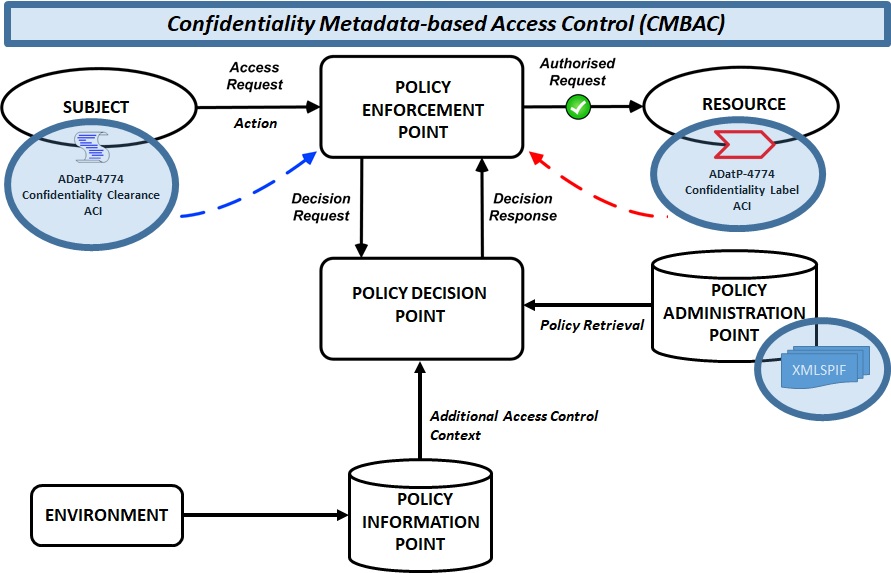
cmbac

DCS ML 3: Cryptographic Protection (DCS-3) – NATO are currently developing an interoperable, standardised and federated approach for achieving DCS-3.

Tags: , , ,

CWID, the Coalition Warrior Interoperability Demonstration, is the premier annual event that enables U.S. Combatant Commands, national civil authorities and the international community to investigate and assess command and control (C2), communications systems, intelligence, surveillance, and reconnaissance (ISR) solutions.

One of the “notable interoperability highlights” identified in this year’s Final Report is that a CWID 2010 trial:

“Demonstrated a potential cross-domain solution to e-mail services, Extensible Messaging and Presence Protocol (XMPP) chat services, web services, and document sharing all of which were governed by a common security policy based on open standards to meet the requirements for providing a network enabled capability.”

This refers to a trial run by the UK to demonstrate Cross Domain Chat between the UK, USĀ and NATO. The trial adopted the XMLSPIF schema in order to provide a revisable, extensible schema that could support widespread adoption. The UK were able to represent the US and NATO Security Labelling policies with this standard and hence define the equivalent security labels to support mapping of labels within Cross Domain Services. The UK SPIF was stored in the X.500 / LDAP Enterprise Directory and a number of services then retrieved the SPIF, via LDAP, in order to display and apply Security Labels, and also make Access Control Decisions.

Appendix C of UK Cross Domain Chat Technical Report contains an XMLSPIF representing UK JSP 457 Volume 7 Electronic Labelling Services used in the trial.

A new version of the XMLSPIF schema is now available. It includes new features requested by members to support their customers’ requirements. These new features include:

  • Validity periods for the whole policy and individual category values.
  • MarkingData and MarkingQualifiers for the SPIF, privacy marks and tag categories.
  • Enhanced constraints on the number of privacy marks and tags that can be selected.
  • Date format specification for category values containing a date.
  • Required categories for an equivalent policy, classification and categories to provide enhanced equivalency mappings.
  • Equivalency between tag sets, where the tag values are the same in each tag set. For example, ISO3166 country codes.
  • Fixes to the schema constraints.

Version 2.0 of the schema replaces Version 1.0 of theĀ schema at:
http://www.xmlspif.org/schema/xmlspif.xsd

The Version 2.0 schema is backwards compatible with Version 1.0. However, for those people who wish to specifically reference Version 1.0 of the schema, it is still available at:
http://www.xmlspif.org/schema/2009/03/xmlspif.xsd